
Why Your Website Is Invisible in the AI Era
Zach Custer
January 26, 2026
Since 2009, the path to search dominance followed a predictable script: find a keyword, optimize the content, build a few links, and wait for the traffic.
But after 17 years in the industry, even the most seasoned veterans are questioning everything. We are witnessing a tectonic shift. AI has flooded the ecosystem with mass-produced, low-value content, prompting Google to execute some of the harshest "crackdowns" in the history of the web.
Yet, despite the headlines claiming AI has killed SEO, the reality is a massive wake-up call for the unprepared. Google still processes 5 trillion searches per year—a reach roughly 100 times greater than the conversations happening on ChatGPT.
SEO isn't dead; it has evolved into a more sophisticated, high-stakes game. To survive, you must abandon the mechanical playbook of the past and master the new rules of the searcher-result connection.
Truth #1: Traditional SEO is the Floor, Not the Ceiling
There is a common misconception that AI tools just "know" things out of thin air. In reality, tools like Perplexity and Gemini act like highly advanced researchers that go out and browse the web for you. They still use search indexes from Google, Bing, and Brave to find their information.
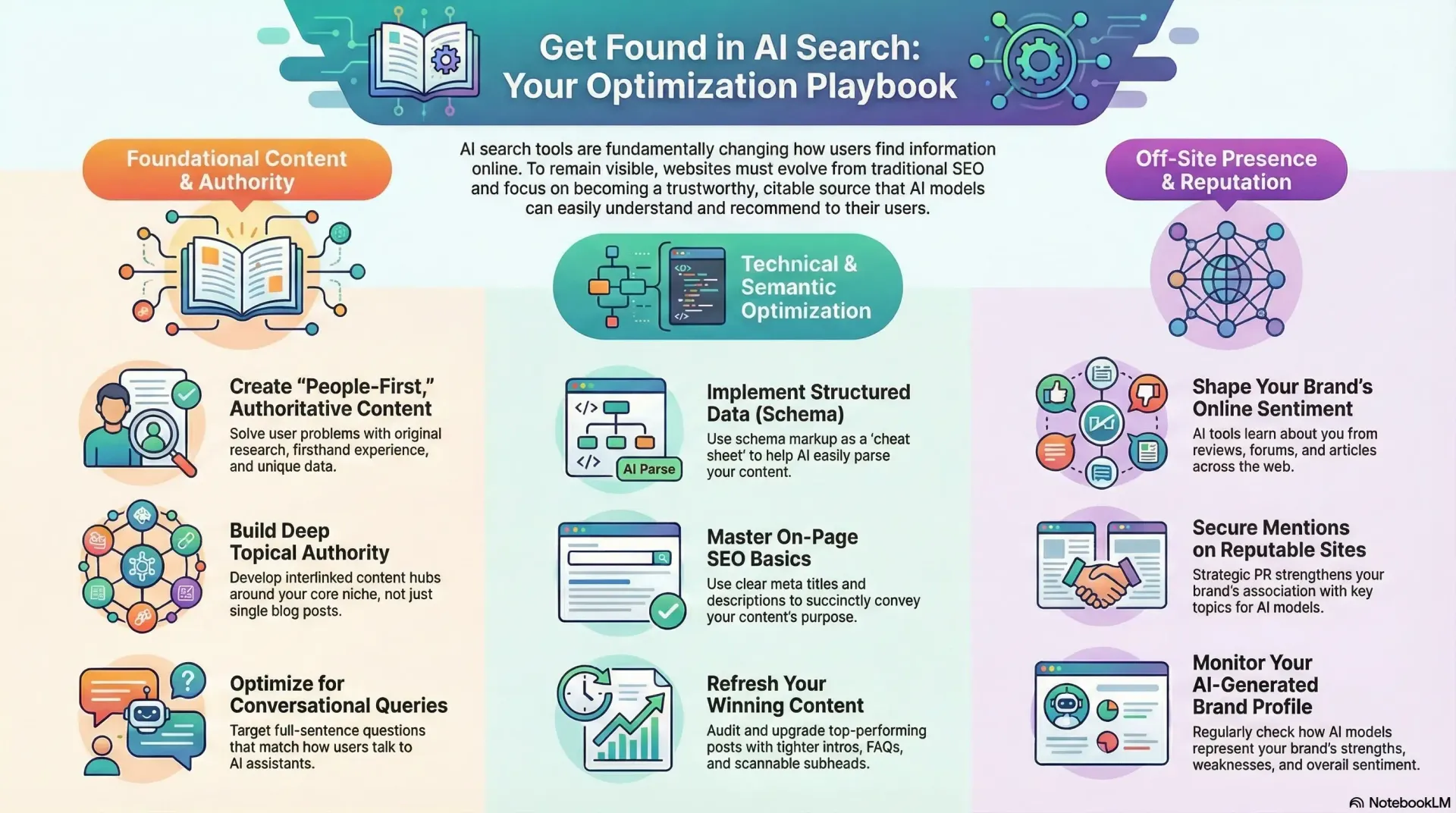
This means that traditional SEO is not dead; it is simply the foundation. If your website is hard for a machine to read, or if you have ignored basic elements like meta titles and descriptions, the AI will likely skip over you. You must have a site that is technically sound so these machines can find and summarize your content quickly.
Think of SEO as your entry ticket to the race. You need it to get on the track, but it won't guarantee you a win in Richland County's competitive market.
Truth #2: Answer Questions, Don't Just Target Keywords
In the past, you might have focused on a single phrase like "Ransomware protection" and hoped for the best. AI search is conversational, meaning people are asking full questions. To show up in an AI's answer, your content needs to speak the same language as the user's intent.
The Shift in Thinking:
• Old Keyword Thinking: "Managed IT services"
• Modern AI Intent: "What are the benefits of managed IT services for a small business in Ohio?"
• Old Keyword Thinking: "Ransomware protection"
• Modern AI Intent: "How do I protect my small business from ransomware on a budget?"
By writing in a natural tone that directly addresses these queries, you help the machines understand that your content is highly relevant to the user’s specific problem. This transition is a core part of how we rebuild content and our approach to digital strategy for local businesses.
Truth #3: AI Can’t Fake First-Hand Experience
AI is excellent at summarizing generic information, but it cannot replicate original research or first-hand experience. If your blog post just repeats the same information found on ten other websites, an AI tool has no reason to cite you as a source. It can generate that generic "garbage" itself.
To be seen as an authority, you must provide something the AI can't create:
• Case Studies: Real-world examples of how you solved a specific problem for a client.
• Original Data: Statistics or insights gathered from your own local projects.
• Testing and Results: Proof that you have personally tried a method and seen it work.
If an AI tool is going to recommend you, there must be a clear justification for it. The machine needs a reason to point users toward your brand instead of just giving a generic summary of the topic.
Truth #4: Local Nuance Beats Generic Content
A national competitor might have a bigger budget, but they lack your Mansfield perspective. AI models are trained to be helpful, and part of being helpful is providing local nuance.
For a business here in Ohio, this means including details that a generic AI summary will miss. If you are a contractor, don't just talk about "roofing." Talk about how North Central Ohio’s heavy snow loads and spring hail storms impact material choices. These "human" details make your content stand out as people-first content. It proves to the AI that you are a real expert operating in a specific community, making you a much more credible recommendation than a faceless national site.
Truth #5: Your Reputation Offline is Now a Ranking Factor Online
AI tools do not just look at your website; they look at your entire digital footprint across the internet. They read sites like Reddit, Apple forums, and niche industry directories like Clutch or G2 to see what people are saying about you.
If other reputable websites and forums mention your brand positively, the AI builds a "sentiment" that you are trustworthy. This is becoming even more critical with the rise of agentic shopping, where people let AI assistants do the research and buying for them. If the AI doesn't see your brand mentioned in community discussions or professional directories, it won't "buy" from you.
Stop thinking only about what is on your own domain. You need to be active where your customers are. Are people discussing your services on community boards? Do you have real reviews on third-party sites?
Exploring resources on understanding brand visibility can help you see how these external mentions impact your overall reach.
Truth #6: Give the Robots a "Cheat Sheet" (Schema)
While you want your content to be conversational for humans, you still need to make it easy for the machines to categorize. This is where Schema Markup comes in. Think of Schema as a technical cheat sheet that you hide in the code of your website.
It tells the AI exactly what it is looking at without the machine having to guess. This technical step is often the difference between being "read" and being "ignored."
Common Schema Uses
• FAQs: Directly providing answers to common questions so AI can pull them into a summary.
• Authors: Proving that a real person with verified expertise wrote the content.
• Services: Clearly defining what you offer and exactly which areas of Ohio you serve.
Conclusion
The technology behind search is moving faster than ever, but the core principle has stayed the same: the most helpful content wins. The difference now is that you aren't just trying to convince a person to click a link; you are convincing an AI to trust you enough to repeat your name as the definitive answer.
2026 is closer than you think, and the businesses that start building their digital authority now will be the ones the AI assistants recommend later. In this new era, you don't just want to be a search result; you want to be the answer.
If a customer asked an AI for the best business in your industry in Mansfield right now, would it have enough evidence to pick you?