

5 Survival Lessons for the AI Era
Zach Custer
January 24, 2026
SEO is Not Dead, It’s Evolving: 5 Survival Lessons for the AI Era
Introduction: The 17-year pivot
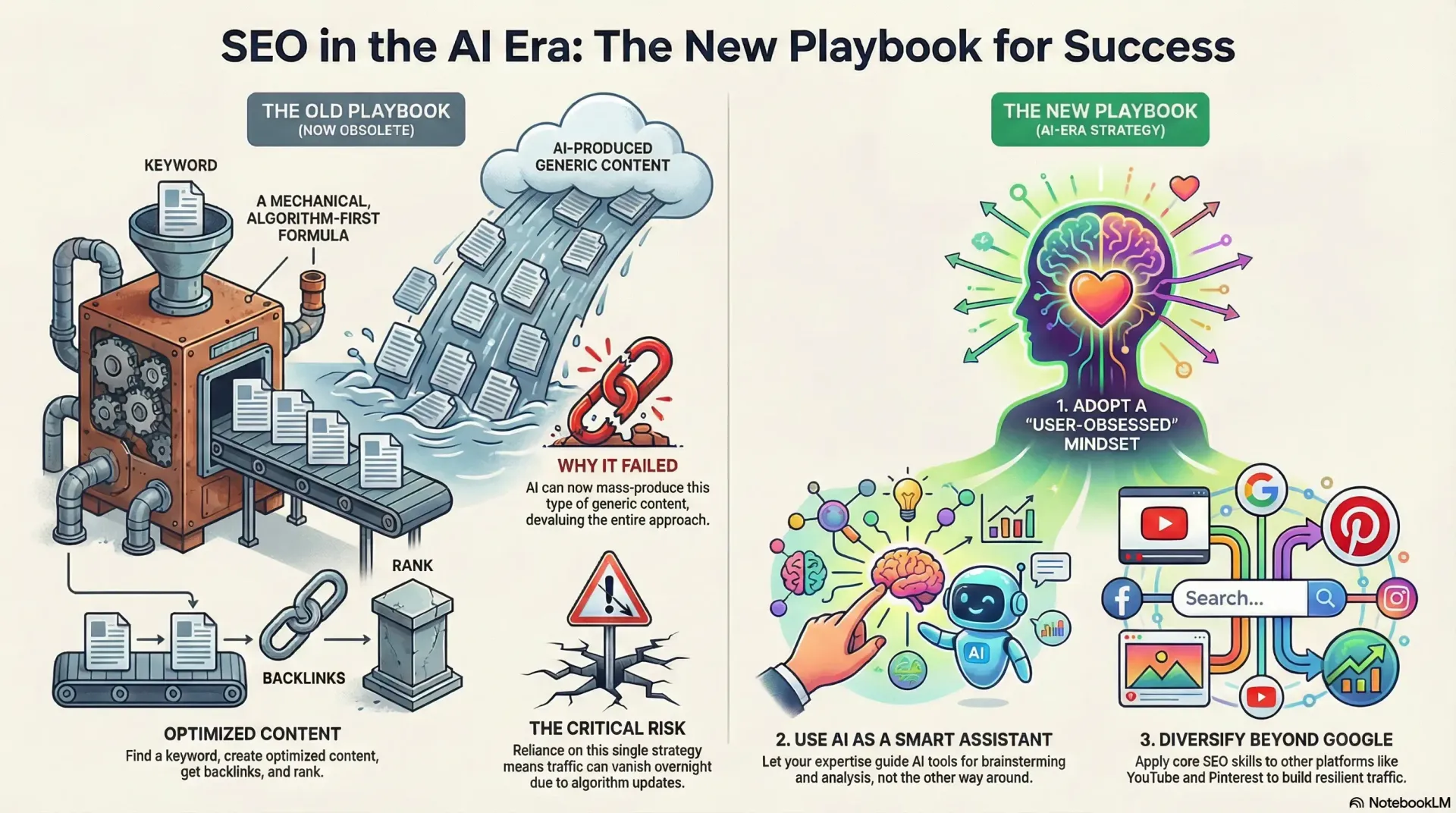
Since 2009, the path to search dominance followed a predictable script: find a keyword, optimize the content, build a few links, and wait for the traffic.
But after 17 years in the industry, even the most seasoned veterans are questioning everything. We are witnessing a tectonic shift. AI has flooded the ecosystem with mass-produced, low-value content, prompting Google to execute some of the harshest "crackdowns" in the history of the web.
Yet, despite the headlines claiming AI has killed SEO, the reality is a massive wake-up call for the unprepared. Google still processes 5 trillion searches per year—a reach roughly 100 times greater than the conversations happening on ChatGPT.
SEO isn't dead; it has evolved into a more sophisticated, high-stakes game. To survive, you must abandon the mechanical playbook of the past and master the new rules of the searcher-result connection.
Takeaway 1: The "Mechanical Playbook" is Officially Obsolete
The era of "SEO copywriting" is over. This was the mechanical process of analyzing top-ranking pages, mimicking their structure, and sprinkling in keywords to satisfy an algorithm. Because AI can now replicate this generic, formulaic content at an infinite scale, it no longer offers a competitive advantage.
Google is doubling down on its fundamental mission: rewarding relevancy and utility. Does Google get this right every time? Not even close. But their intent is clear. If your content exists solely to satisfy a ranking factor, you are building on sand. When you write for machines, you become replaceable by machines.
"Search engines don't buy from you, people do."
If you aren't providing value that transcends the "mechanical," you risk being erased in the next update.
Takeaway 2: Transition from Keyword-Focused to User-Obsessed
The new era demands a pivot from "How do I rank?" to a user-obsessed mindset. You must stop obsessing over search volume and start obsessing over the human on the other side of the screen.
Consider someone searching "how to start a YouTube channel." A mechanical SEO looks for headers; a visionary SEO looks for motivation and intent.
• Is the searcher a total beginner or a seasoned creator looking for a niche?
• Are they seeking a creative outlet or financial gain?
• Do they need a step-by-step tutorial, a gear checklist, or an interactive guide?
When you understand the searcher’s underlying goal, you provide the format they actually need. This builds the trust and engagement that drives conversions, turning a simple click into a long-term customer relationship.
Takeaway 3: Become the "Operator," Not the Outsourcer
AI tools are one of the most revolutionary technologies since the internet itself, but they are assistants, not replacements. Your success depends on your ability to be an "Operator."
The difference is clear when comparing "Joe Schmo" to "Sam Edward O." A novice (Joe) lets the AI guide him, resulting in robotic, generic content that Google ignores. An expert (Sam) uses SEO fundamentals to perform his own keyword and audience research first. He then uses those insights to "operate" the AI, guiding it to execute a specific, high-level strategy.
The power of being an Operator is real: by maintaining the steering wheel, an expert can use AI to rank #1 on Google in just one hour. AI does not grant you skills; it amplifies the skills you already possess.
Takeaway 4: SEO is a Universal Language, Not Just a Google Skill
To thrive in the future, you must look beyond the Google silo. SEO is the universal language of the searcher-to-result connection. The core principles—keyword research, understanding intent, and link building—apply to any ecosystem that sorts content by user queries.
Mastering these fundamentals allows you to diversify and protects you from unpredictable traffic drops on any single platform. This skill set is your ticket to dominating:
• YouTube (where SEO can drive millions of views)
• Reddit and Quora
• eBay and Amazon
If you can master the logic of search on Google, you are already miles ahead of the competition on every other platform on the planet.
Takeaway 5: You Must Be "Worth Finding"
In an ocean of mediocre, AI-generated content, uniqueness is your only moat. Simply existing is no longer enough. If your content is just a recycled version of what already sits on page one, you are invisible. You must offer a perspective, a data point, or a level of utility that a machine cannot simulate.
"In a world where AI can turn out endless mediocre content, copying what already exists isn't enough—and honestly, it shouldn't be enough. You need to be worth finding."
In the AI era, brand-building and SEO are the same thing. If you aren't providing something unique, you aren't just failing at SEO—you are becoming obsolete.
Conclusion: The Future of the Searcher-Result Connection
The evolution of SEO is a forced march from mechanical optimization to genuine utility. As search engines get better at filtering out the noise, the winners will be those who use AI to scale their productivity while keeping their human-led strategy at the forefront.
The survival of your digital presence hinges on one question: If a searcher finds your content today, is it genuinely useful enough to survive the next era of search? If not, the time to return to the fundamentals and focus on the user is now.